Radio emission from AGN-driven jets and winds
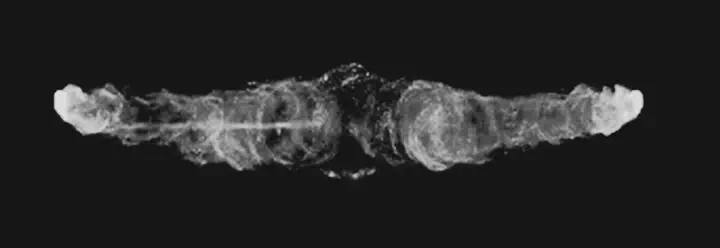 Synchrotron emission from large-scale FR-II like jets
Radio emission from active galactic nuclei (AGNs) is ubiquitous, yet the physical mechanisms behind it are not always straightforward to disentangle from observations alone. Using relativistic-magnetohydrodynamic simulations, I investigate how AGN-driven jets and winds evolve and interact with their surroundings, and how these processes shape the radio emission and observable diagnostics of AGN feedback.
Some animations:
Animations from A polarization study of jets interacting with turbulent magnetic fields. The time evolution of the non-thermal synchrotron flux at viewing angles of 90 (left: half-plane) and 45 degrees (right) for AGN-jets of different powers.
Animations from Non-thermal emission in jets and winds: Expected emission and spectral index distributions showing evolution of cosmic-ray electrons (CREs) in jets and winds. The colorbar indicate the maximum Lorentz factor of a CRE macro-particle.
Mock synchrotron intensity from a large-scale high-power FR-II like jet. Simulation is performed using RMHD code PLUTO.